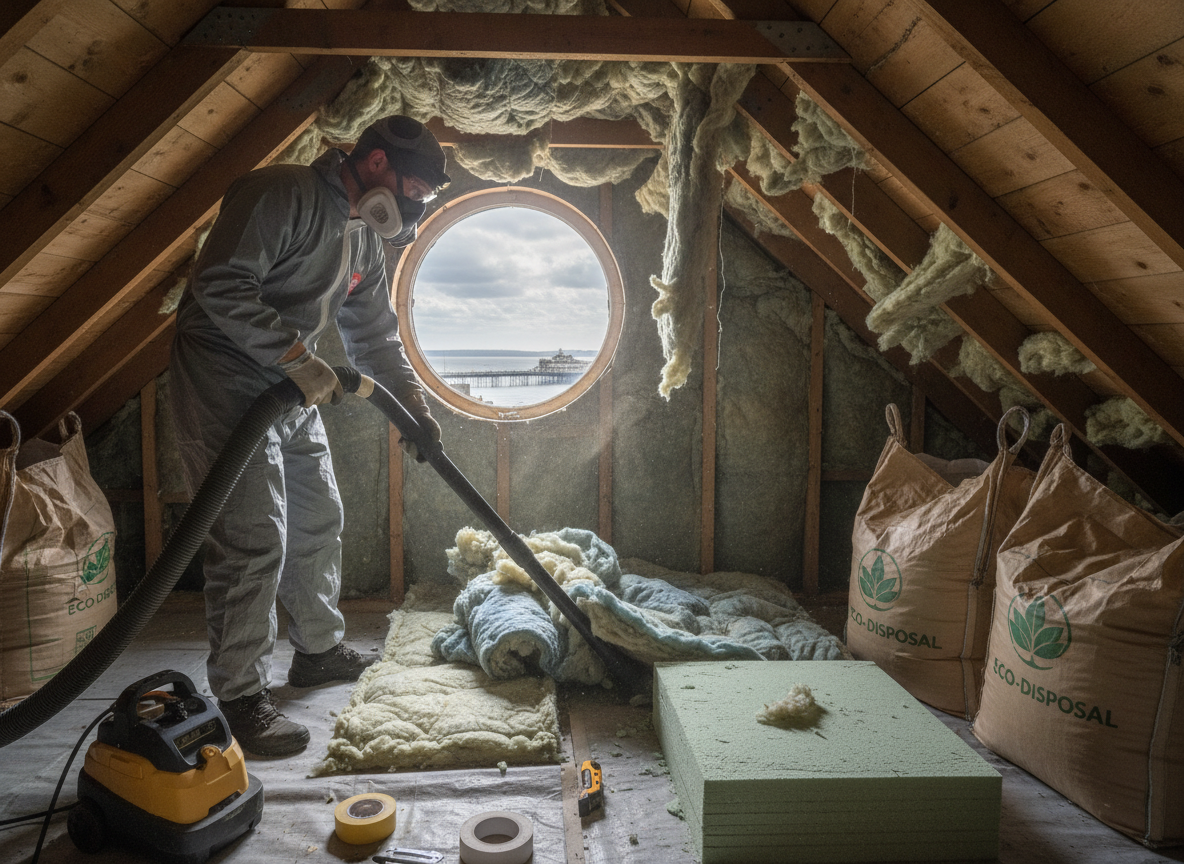
Weston Super Mare properties often feature loft spray foam installed in Victorian terraces and 1930s semis around areas like Clarence Road and the seafront. Coastal humidity and salt air frequently cause the foam to trap moisture against timber joists, leading to hidden rot that only appears once removal starts. Environmentally friendly methods require full containment sheeting, HEPA filtration and segregated bagging to prevent loose particles entering the local drainage system that feeds into the Bristol Channel.
Standard removal here involves cutting the foam in controlled sections rather than aggressive scraping, which reduces fibre release in older homes with narrow roof voids common in the Locking Road and Ashcombe Park neighbourhoods. Disposal follows UK hazardous waste rules by transporting material to licensed Somerset facilities instead of landfill. Homeowners should expect extra time for properties near the beach where wind-driven rain has already saturated the insulation, increasing the risk of mould spores becoming airborne during extraction.
Edge cases include foam applied over original lath and plaster ceilings in listed buildings around Grove Park, where vibration from removal tools can crack fragile plaster. Technicians test adhesion first and use low-impact solvents only when necessary to avoid damaging underlying timbers. Post-removal inspection checks for remaining residue that could affect new insulation performance in Somerset's damp winters.
Coastal Moisture Considerations
High salt content in the air along Weston Super Mare's promenade accelerates foam degradation, often creating brittle layers that fragment easily and require slower, section-by-section removal to keep waste contained.
Technician insight
In Weston Super Mare, the thing that catches most people out with environmentally friendly insulation removal is how sea air moisture in older terraces near the beach makes the foam bond tighter to joists than expected, so you have to slow the cut rate or risk pulling plaster off ceilings in the rooms below.
Loft Clearance in a Seafront Terrace
Homeowner in a 1920s property near the promenade reported musty smells after heavy winter rain. Inspection showed saturated spray foam trapping moisture against original timbers. We used sectional cutting under full containment, bagged all material for licensed Somerset disposal and left the void clean and ventilated. Air quality improved and the owner could proceed with new insulation without further rot risk.
How it works
- 1
Initial Assessment
Inspect loft access, foam depth and moisture levels in the specific property to plan containment.
- 2
Containment Setup
Install sealed barriers and filtration to protect living spaces from particles during extraction.
- 3
Controlled Removal
Cut and bag foam in sections using methods that minimise dust and protect original timbers.
- 4
Eco Disposal
Transport waste to licensed Somerset facilities and clean the void for follow-on works.
- 5
Final Verification
Check for residue and confirm the space is ready for new insulation or ventilation upgrades.
Pricing
Upfront quotes based on access difficulty, foam thickness and property age; 24/7 availability from the Clarence Road base.