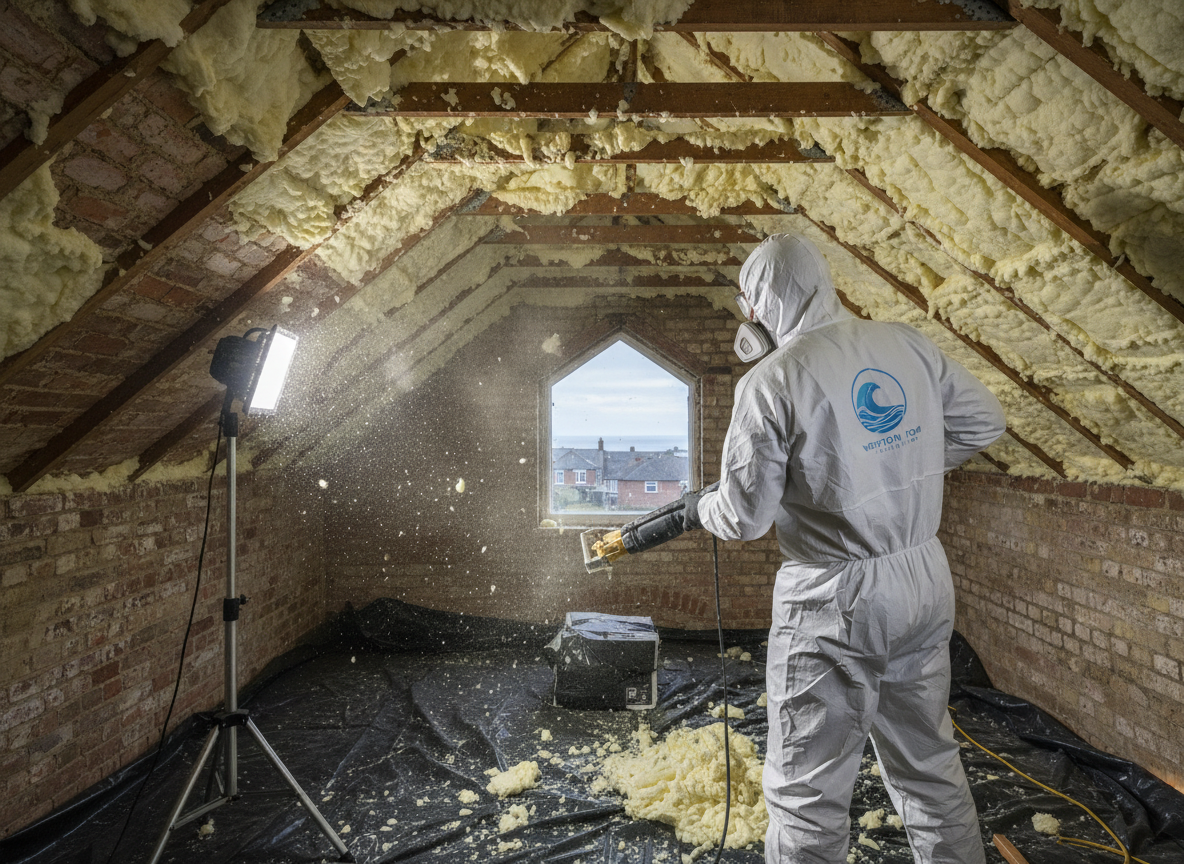
Open cell spray foam was commonly installed in Weston Super Mare lofts during the 2000s and 2010s to improve insulation in Victorian and Edwardian terraces. Over time the material absorbs moisture from the sea air along the Bristol Channel, leading to reduced performance and occasional mould growth on timber joists. Removal requires careful cutting and vacuum extraction to avoid damaging original lath and plaster ceilings below, especially in properties near Clarence Road and the seafront.
Homeowners in areas such as Worle and Uphill often discover the foam has expanded into electrical cables and pipework during initial surveys. Extraction teams must isolate power and work around fragile slate roofs that are typical of the region. Leaving residue can trap damp against the roof deck, accelerating rot in the wet Somerset winters.
Regulatory guidance now advises against covering open cell foam with new insulation without full removal in many cases. Local building control officers in North Somerset expect evidence that the foam has been completely extracted before re-insulating, particularly where roof ventilation has been compromised by the original installation.
The job is slower in Weston Super Mare than inland because salt residue on the foam requires additional rinsing to prevent corrosion on metal fixings. Teams working from the 7-9 Clarence Rd N base carry portable extraction units suited to narrow terraced lofts that lack easy access.
Technician insight
In Weston Super Mare the thing that catches most people out with open cell spray foam removal is how the salt-laden air keeps the foam slightly damp even months after it stops performing, so it sticks tighter to the joists in older terraces near the seafront than it does inland.
Worle Loft Extraction
Homeowner in Worle reported musty smells after years of open cell foam. Survey found moisture trapped against the roof deck in a 1930s semi. Crew removed all foam, cleared residue from joists and confirmed improved airflow before re-boarding.
How it works
- 1
Site Survey And Moisture Testing
Technicians inspect the loft, measure foam depth and check for hidden moisture pockets common in coastal properties.
- 2
Isolation And Protection
Electrical circuits are isolated and floors plus remaining insulation are protected before cutting begins.
- 3
Mechanical Removal
Foam is cut into sections and removed using specialist vacuum equipment to limit dust spread in older homes.
- 4
Final Clean And Ventilation Check
Residual material is vacuumed away and roof ventilation is assessed before handover.
Pricing
Costs depend on loft size, foam thickness and access difficulty; upfront quotes provided after survey.