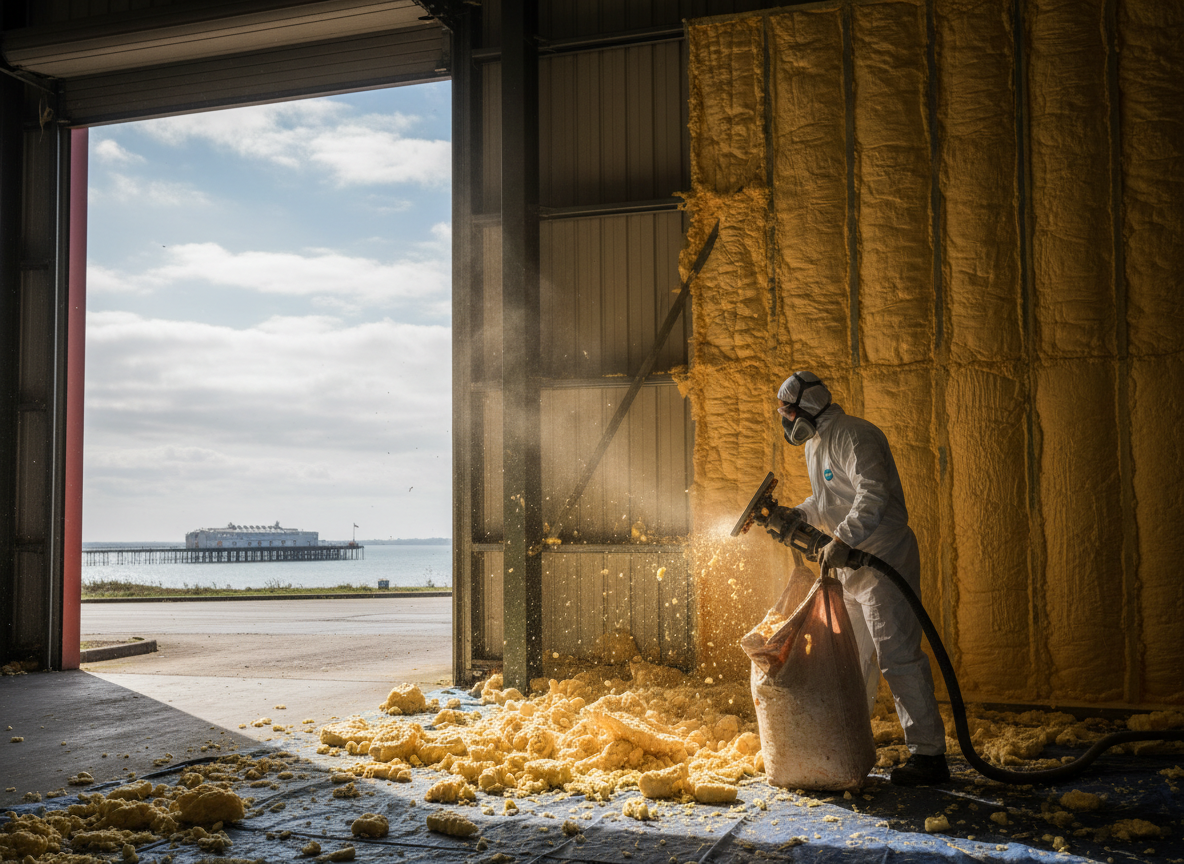
Warehouses in Weston Super Mare often feature older steel-framed or concrete structures built during the mid-20th century expansion of the town's port and manufacturing zones. Spray foam applied to roofs and walls for insulation frequently traps moisture against metal cladding, leading to corrosion that accelerates in the area's salty coastal air and frequent high winds. Removing it requires careful section-by-section work to avoid damaging purlins or releasing fibres into the open floor space below, where goods or equipment may still be stored.
Somerset planning rules and building regulations around thermal upgrades mean any re-insulation after removal must meet current U-value standards, especially in buildings converted from pure storage to mixed-use. Large open spans make dust containment difficult, so negative-pressure setups and sealed skips are standard to prevent contamination of nearby residential streets such as those around Clarence Road. Workers also check for asbestos in older insulation layers common in 1960s-1980s warehouses before starting mechanical removal.
Moisture levels in Weston Super Mare's ground conditions can rise through slab floors during prolonged wet winters, undermining any remaining foam adhesion at wall bases. Technicians therefore test substrate dryness and recommend targeted ventilation upgrades rather than blanket re-spraying. Access via roller doors or high-level gantries is planned around normal business hours to minimise disruption to tenants on the Locking or Winterstoke industrial estates.
Technician insight
In Weston Super Mare the thing that catches most people out with warehouse spray foam removal is how quickly coastal wind drives salt-laden moisture behind the foam on metal roofs, so you end up chasing corrosion along the entire purlin run rather than just peeling off the insulation layer.
Winterstoke Road Warehouse
A storage unit near Winterstoke Road showed sagging foam on the north elevation after heavy winter rain. Inspection found trapped moisture had corroded several steel purlins. We set up full negative pressure, stripped the foam in controlled sections, treated the metal and cleared the site within two days so the tenant could resume operations without stock damage.
How it works
- 1
Site Survey And Risk Assessment
Measure warehouse dimensions, identify foam thickness and substrate condition, and check for asbestos or electrical hazards around the Clarence Road area.
- 2
Containment And Ventilation Setup
Erect negative-pressure enclosures and dust extraction to protect stored goods and prevent fibre drift into surrounding Somerset streets.
- 3
Foam Removal And Substrate Cleaning
Use mechanical scrapers and vacuums to strip foam from roof and walls while monitoring for hidden corrosion in steel frames.
- 4
Waste Disposal And Final Inspection
Bag and remove all debris to licensed facilities, then verify the space meets cleanliness standards for re-occupation or re-insulation.
Pricing
Cost depends on warehouse floor area, foam depth and access restrictions; larger industrial units on the outskirts typically require more containment than smaller town-centre buildings.